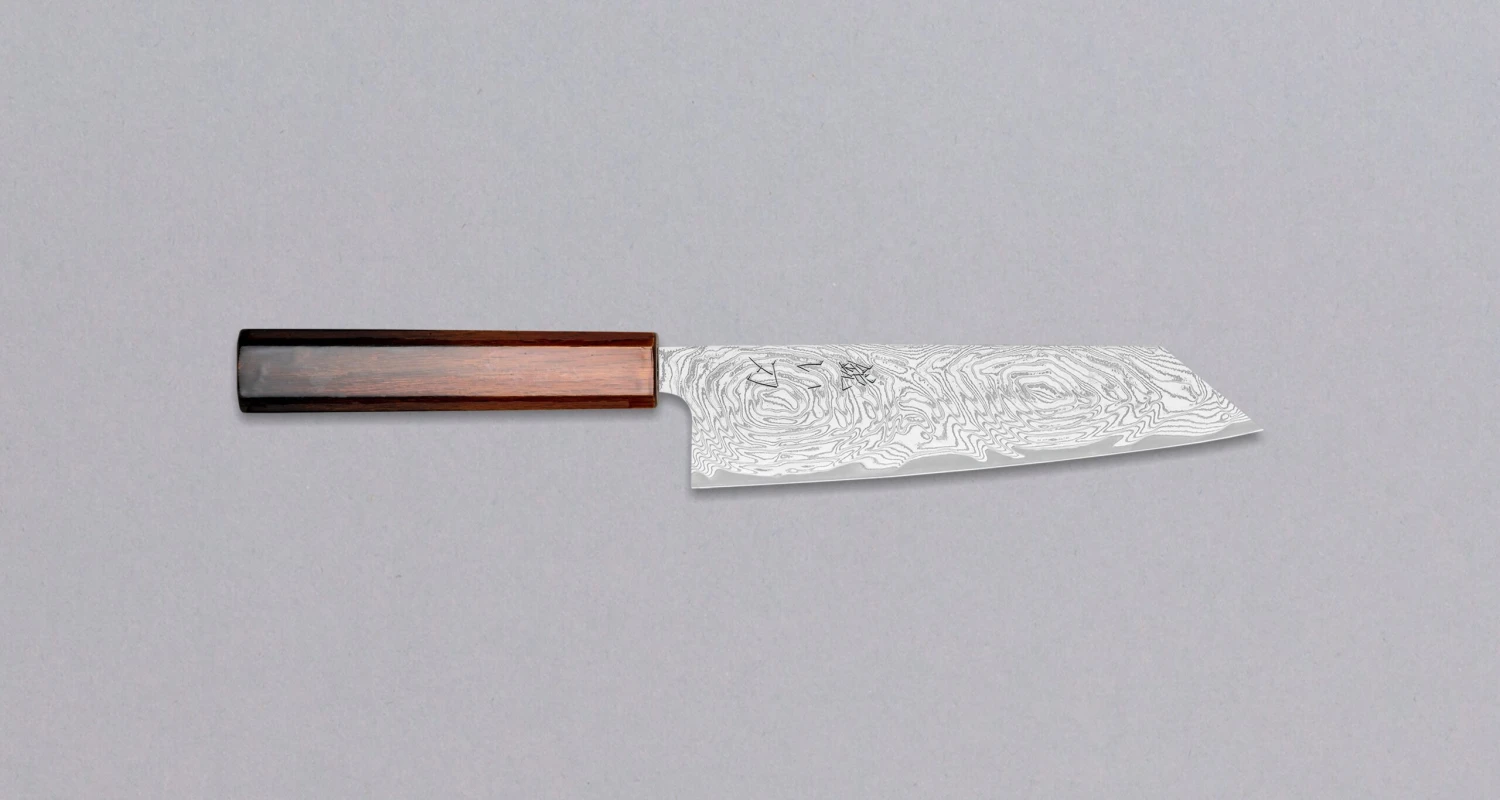
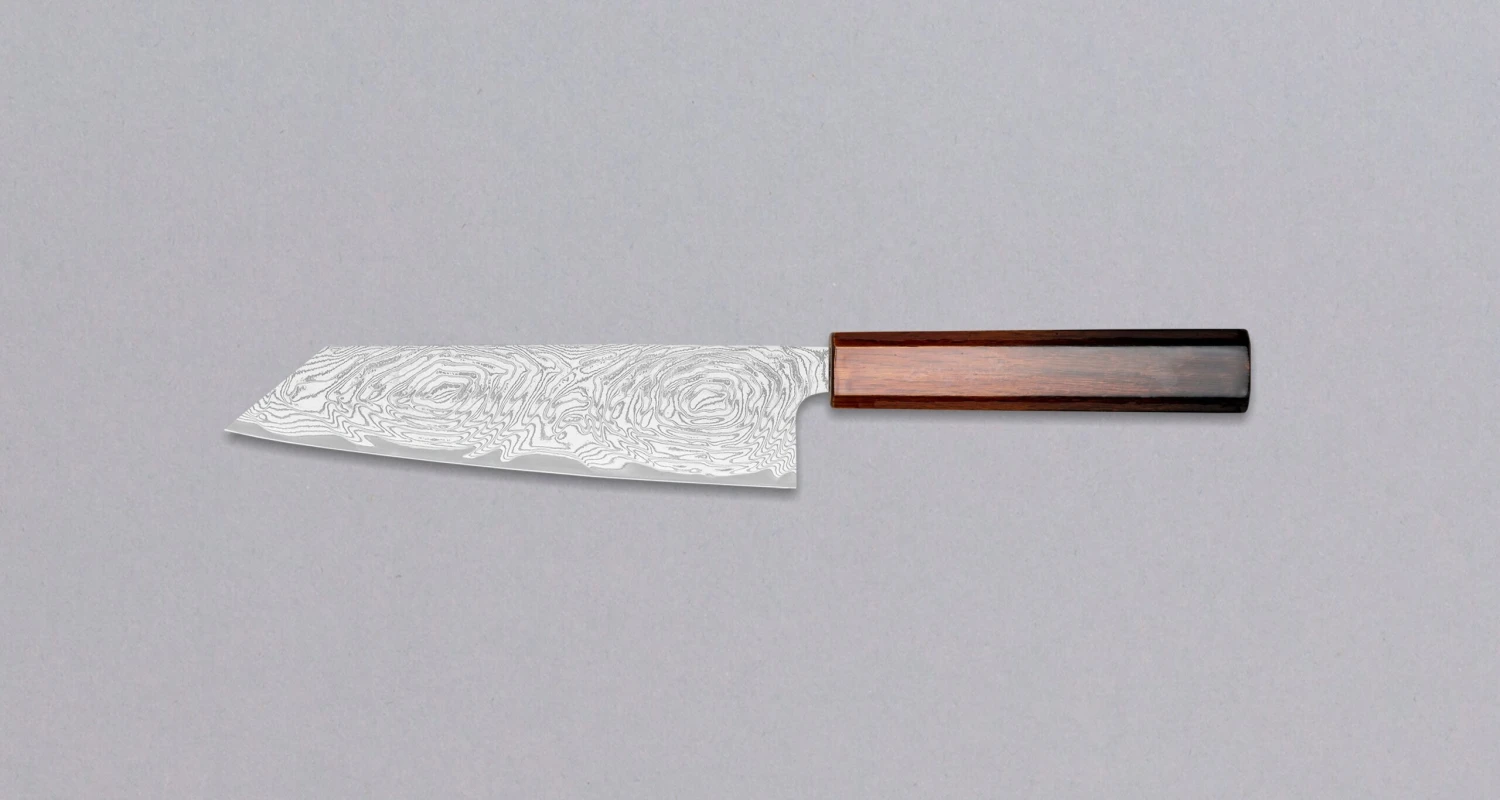
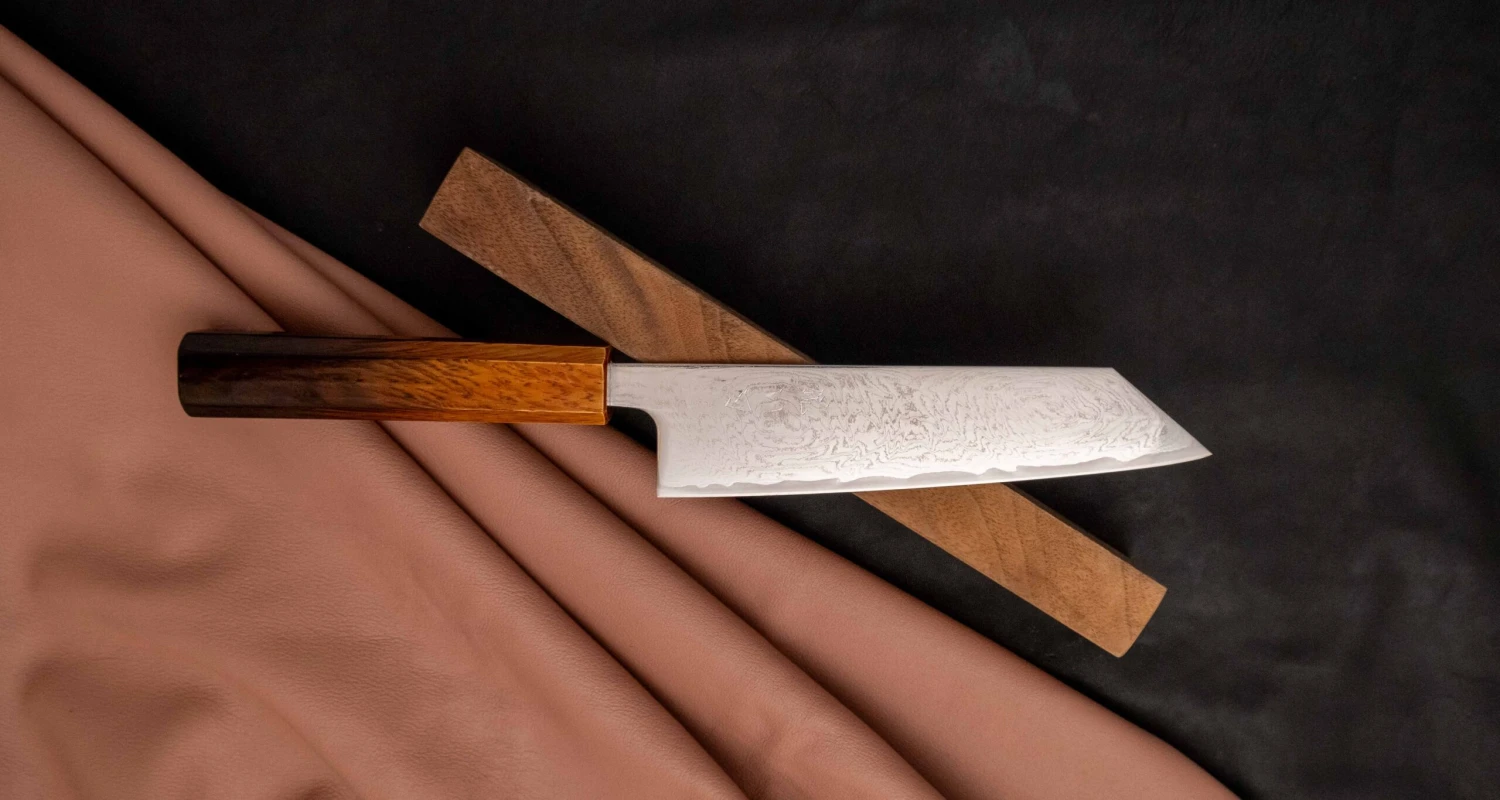
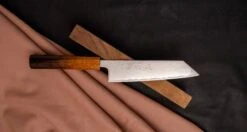
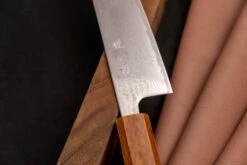


Hokiyama Petty AUS-10 Swirl Damascus is a small, handy bunka blade with a stunning damascus blade finish. The bunka shape works great for preparing vegetables, meat, and fish, and this smaller version is great for people who find larger knives too unwieldy, as it offers great control for either short of long cuts. The thin pointy reverse tanto tip allows for extra precise cuts and carvings.
BLADE SHAPE:
Bunka is one of the most versatile and useful blade shapes in the modern kitchen. It has a wide profile for easy food transfer and tends to be fairly flat towards the heel, enabling easy and fast chopping on the cutting board. A pointed tip allows piercing and precise, delicate work. A slight curve between the tip and the midsection makes the belly great for rocking the blade back and forth when cutting. It can be used for cutting meat, fish, and vegetables.
→ You can learn everything you need to know about the Japanese bunka knife in our article.
STEEL:
The heart of this bunka is made of Aichi’s AUS-10 stainless steel, which was hardened to around 59-60 HRC. Due to its high content of Chromium (Cr), AUS-10 steel will resist corrosion very well.
BLADE FINISH:
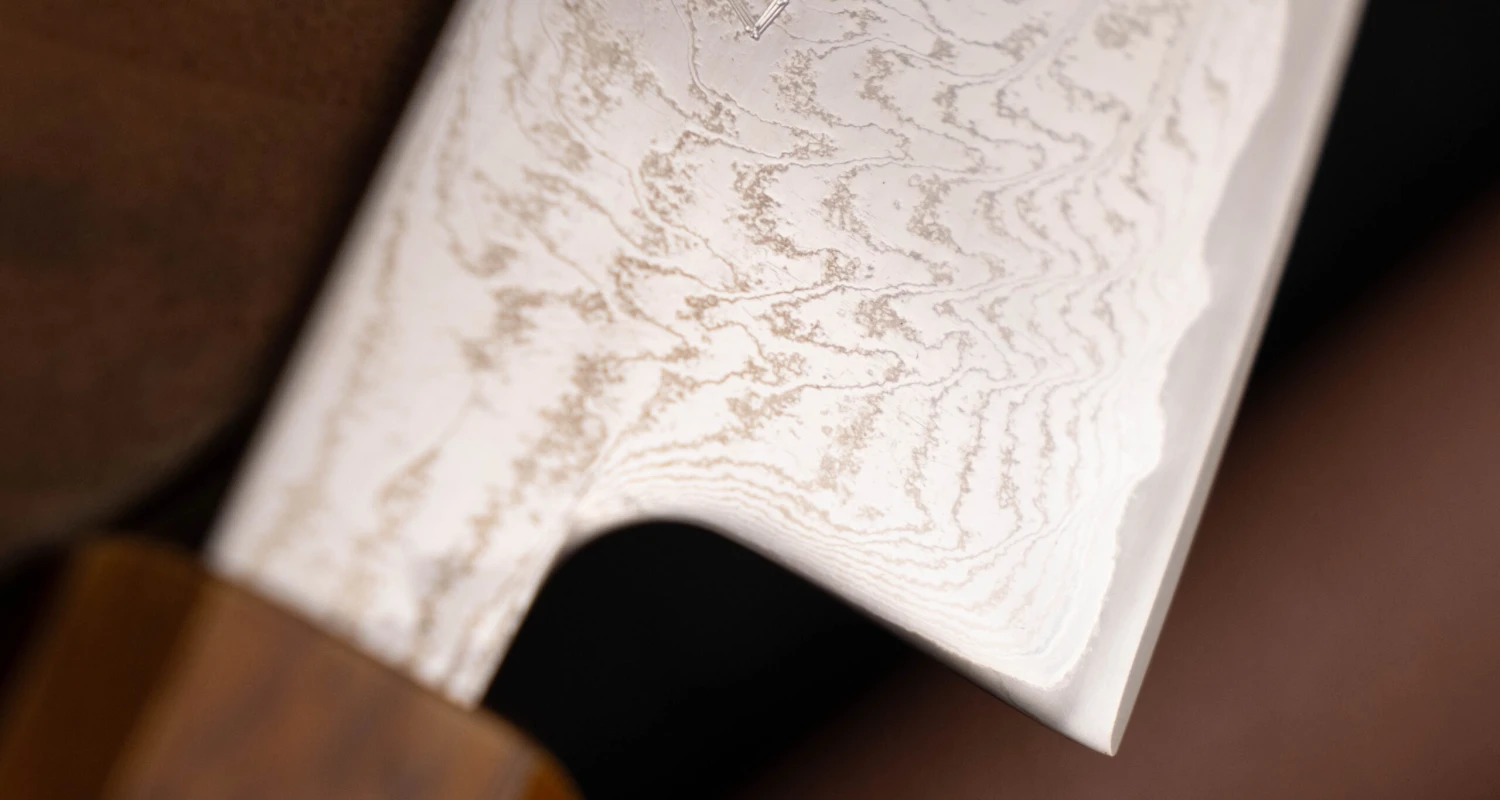
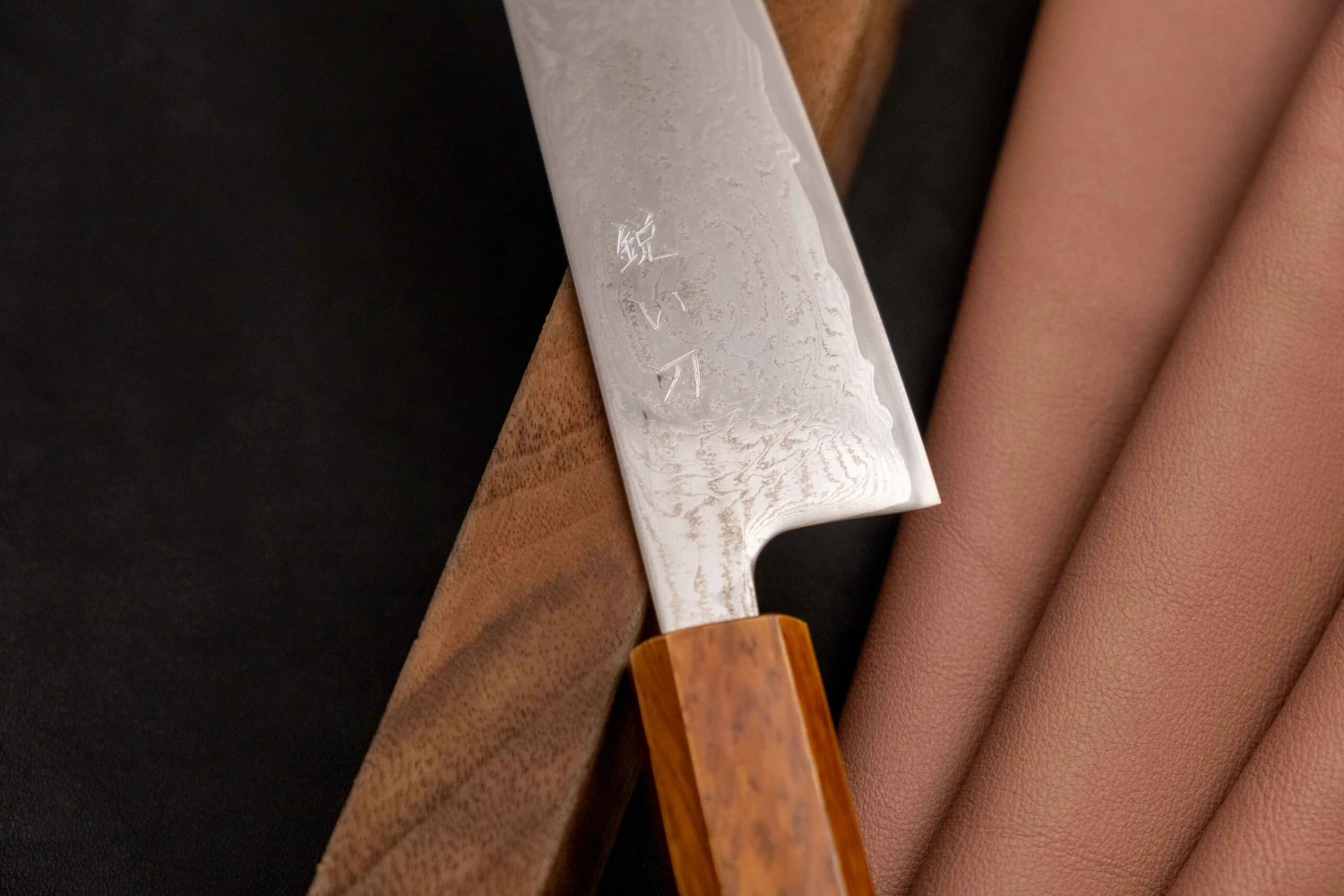
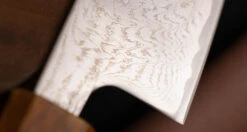
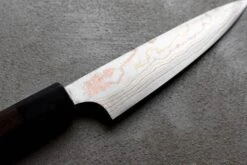
A very distinct 33-layered Damascus pattern enriches the visuals of the blade – this pattern is unique to every knife and cannot be replicated. The damascus pattern is in parts round and curvy, hence the name “Swirl Damascus”. Like your fingerprint, not one blade is alike. The entire blade is polished to a reflective mirror polish. You can see yourself in it!
BLADE GEOMETRY:
The blade has a double bevel (symmetrical) blade (50/50) with a flat v-edge grind, so it is suitable for both left- and right-handed users. It tapers distally towards the tip.
LAMINATION:
At the very edge, one can spot a pronounced, curvy line (matte finish) that travels along the entire length of the blade. This is the line between the core and the 33 softer, outer layers of steel that serve as additional protection of the core steel. Such a sandwich of the harder core steel and softer outer steel layers is called san-mai clad. Most of today’s Japanese knives are made this way.
HANDLE:
A traditional Japanese handle of octagonal shape, made of oak wood. Without a ferrule, this handle is anything but minimalistic. In an elegant, very glossy gradient, the natural reddish color of the wood slowly darkens from the top toward the bottom of the handle. The octagonal handle offers a good grip, and the sleek indentation-free surface ensures easy cleanup and maintenance.
The slightly flattened octagonal shape of the handle helps it align well with the cutting board, and its symmetrical shape makes it suitable for both left- and right-handed users. This handle provides excellent blade control when slicing. Additionally, the compact grip minimizes the possibility of slipping during use. The whole handle is made of one piece of wood (without a ferrule).
What is urushi?
Urushi is the sap of the urushi tree, also known as the lacquer tree or the Japanese varnish tree. The sap contains resin urushiol, which becomes a very hard, shiny, durable lacquer when exposed to air and moisture.
In early Japan, people recognized urushi’s durability and beauty and began using it to coat wood, pottery, and all kinds of other objects to protect and strengthen them. Fully cured Urushi is resistant to alkali, acids, and alcohol and can withstand extreme temperatures!
Urushi lacquering is deeply connected to Japanese culture, and its mastery requires a lot of training. The skills and techniques in use have been passed down for many centuries. Each layer is dried and polished before the next one is added, which makes the urushi process time-consuming and labor-intensive. This application, as well as the difficult harvesting and highly technical processing of the raw material, make traditionally lacquered items highly desirable and expensive.
Urushi is foodsafe and has been used on tableware for centuries, most famously on Japanese rice and miso bowls.
BLACKSMITH:
Hokiyama Hamono is a leading smithy in Kochi Prefecture in Japan. They have recently celebrated their 100-year anniversary, founded in 1919. Hokiyama Hamono is known for their quality as they follow the tradition of hand-made blades that has been around for over 800 years. They retain the handiwork and traditional craftsmanship that is passed down from generation to generation, while striving for the ever-new knowledge and innovation.
Be the first to review “Hokiyama Bunka AUS-10 Swirl Damascus 170mm (6.7″)”
Related products
The Cutting List
Japanese Knives
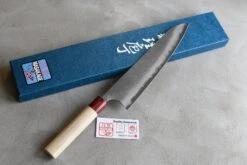
Gyuto [Chef's knife]
Gyuto [Chef's knife]
![Tsunehisa Gyuto Aogami Super Kuro-uchi 210mm (8.3") [Rosewood-Cedar]](https://www.kniveshotdeal.com/wp-content/uploads/2025/11/410103111038-_1__rosewood-247x132.webp)
Gyuto [Chef's knife]
Tsunehisa Gyuto Aogami Super Kuro-uchi 210mm (8.3″) [Rosewood-Cedar]
Japanese Knives
Japanese Knives
![Yu Kurosaki Gyuto Senko R2 270mm (10.6") [Rosewood]](https://www.kniveshotdeal.com/wp-content/uploads/2025/11/KurosakiGyutoSenko270mm_410103201222_1-247x132.webp)
Gyuto [Chef's knife]
Reviews
There are no reviews yet.