
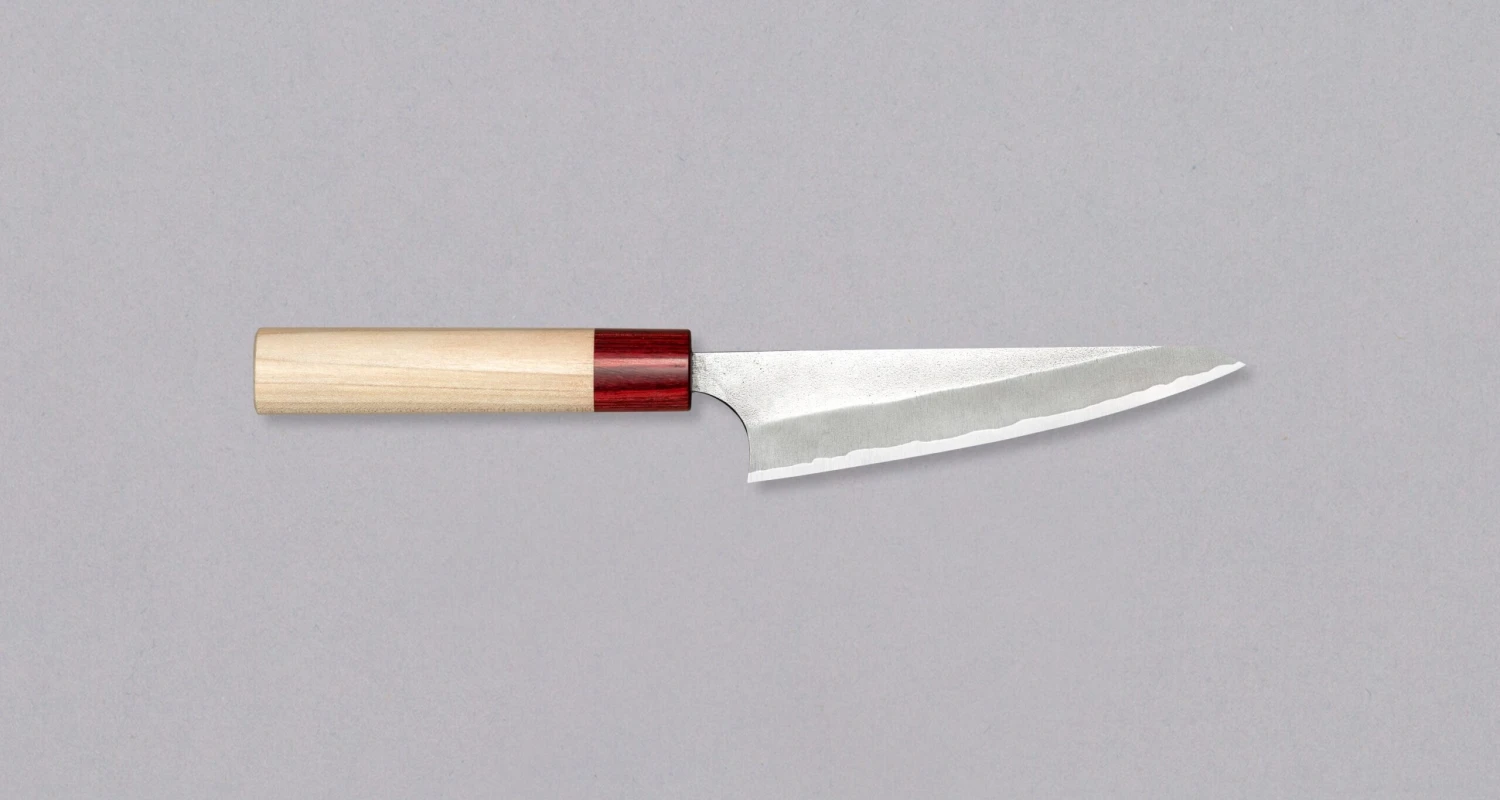
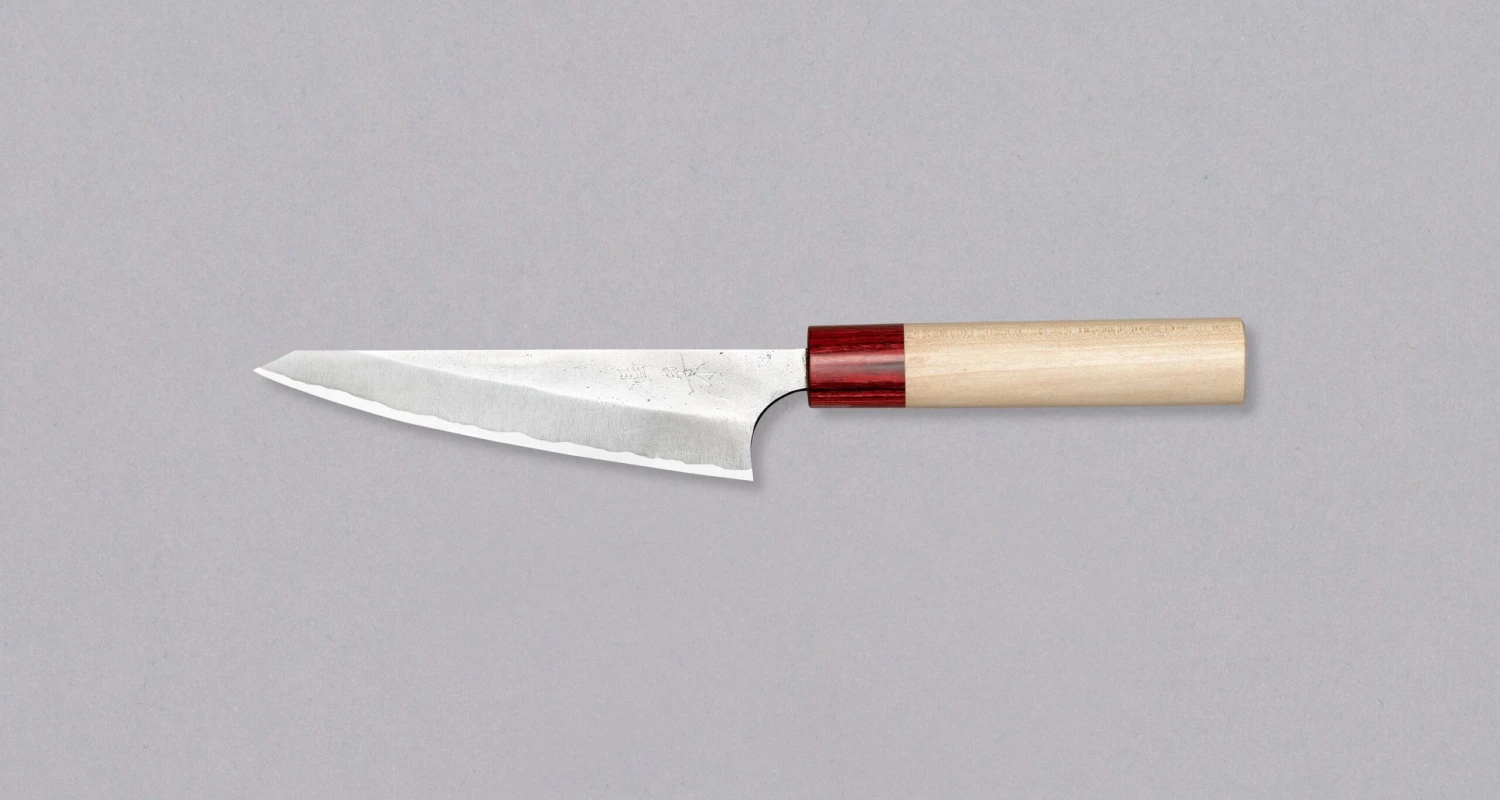
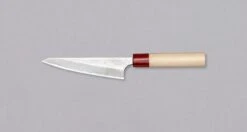


The striking collection by the brand Masakage and blacksmith Yoshimi Kato is called Yuki – snow. The subtle whiteness of the blade and the light magnolia handle are designed to remind one of a snowy winter landscape. With a carbon steel core and stainless outer layers, this line represents the perfect blend of beauty and performance.
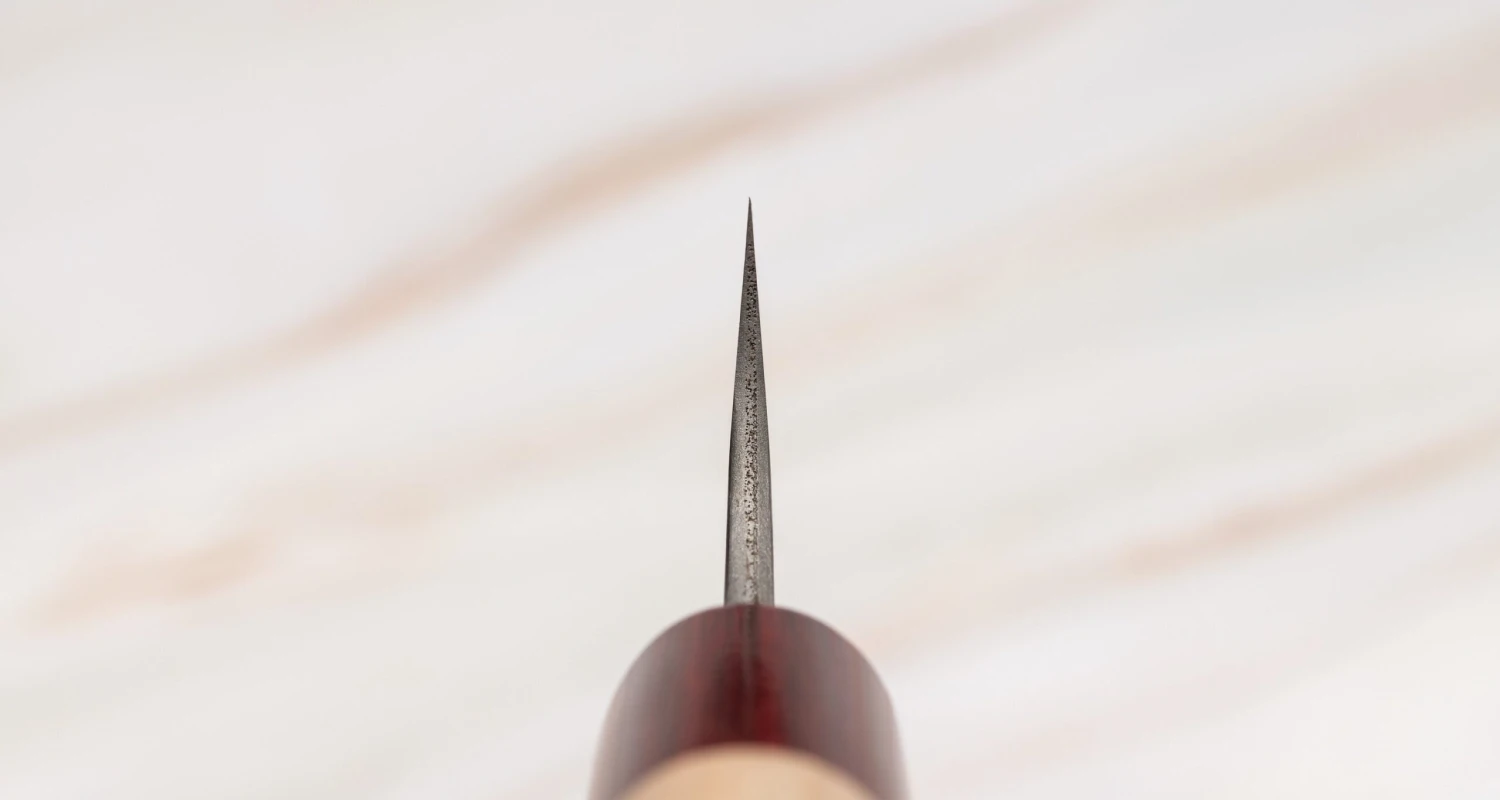
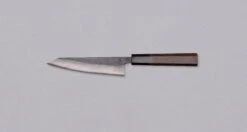
Kato Yuki Honesuki 150mm (5.9″) is a Japanese boning knife, intended for the preparation of poultry and smaller animals such as rabbit. Whereas it is not suitable for cutting through bone, it handles cartilage and tendons wonderfully, and its sturdy heel can be used for scraping meat off the bones. The reverse tanto tip design increases the strength of the tip, which can be used to easily pierce the skin, as well as to make precise cuts in tight spots, like the joints. Its shape also allows for making quick turns, great for trimming away fat and connective tissue.
BLADE SHAPE
Honesuki is a Japanese boning knife. As the name already suggests, it is used for removing the bones from meat, poultry, and fish. The blade’s handle and shape allow for a variety of grips and cutting techniques, especially useful when working around the bone. It is suitable for anyone looking for a slightly heavier but perfectly balanced knife with a super thin and precise blade. Boning knives are to be used around the bones, but not for cutting through them – the blade is too thin, which can result in a chipped blade.
STEEL
The knife’s core is Shirogami 2 (White 2) steel, surrounded by two layers of stainless steel that also hug the blade’s spine. The knife is hardened to 62-63 HRC. The combination of the carbon steel core and stainless outer layers gives us the best of both worlds: easy maintenance and rust protection on one hand, and sharpness, a silky smooth edge, and efficient cutting on the other. With use, the blade will develop a protective patina along the shinogi line. Despite the rust-proof outer layers, the knife must be cleaned with regular and careful dry wiping, and should occasionally be oiled with Ballistol or Camellia oil.
LAMINATION
The blade’s core was laminated using the san-mai method to improve its structural integrity and subsequent ability to withstand impacts and prevent chipping. San-mai translates to “three layers” in Japanese, referring to a blade that is composed of a primary, inner layer of harder steel (hagane) and of two secondary, outer layers of softer steel (jigane) that protect the prior.
→ Read more on Blade Construction: Lamination.
GEOMETRY
It has a double bevel (symmetrical) blade (50/50) with a flat v-edge grind. The blade has a distal taper, starting at 3.5mm (0.14″) and narrowing to 1.8mm (0.07″) at the reverse tanto tip. This gives it more strength and weight at the handle (meaning we can exert more pressure with the heel) and more precision at the tip, allowing for smooth and precise cuts.
BLADE FINISH
The finish of the blade is called Nashiji, the literal translation of the word being “the skin of an (Asian) pear”. It refers to the slightly matted surface of the upper part of the blade, which not only has aesthetic value but is also practical since the uneven surface reduces the sticking of the food to the blade when slicing.
HANDLE
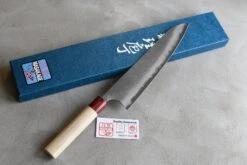
The blade is fitted with an oval white magnolia handle in traditional Japanese style. The red ferrule made of pakka wood gives this very light knife a bit of color for dramatic effect.
Yoshimi Kato, a relatively young blacksmith from the famous Takefu village, known for many skilled blacksmiths, gave the blade a traditional Japanese handle, oval in shape, made of magnolia wood with a ring made of red pakka wood.
The knife is packed in a beautiful box – the natural blue colored paper has silver coloured kanji – signature of the master blacksmith. The box comes with a certificate stamped by the blacksmith and sharpener.
Be the first to review “Kato Yuki Honesuki Shirogami #2 150mm (5.9″)”
Related products
Gyuto [Chef's knife]
Japanese Knives
Gyuto [Chef's knife]
Japanese Knives
Japanese Knives
Japanese Knives
Japanese Knives
Reviews
There are no reviews yet.