

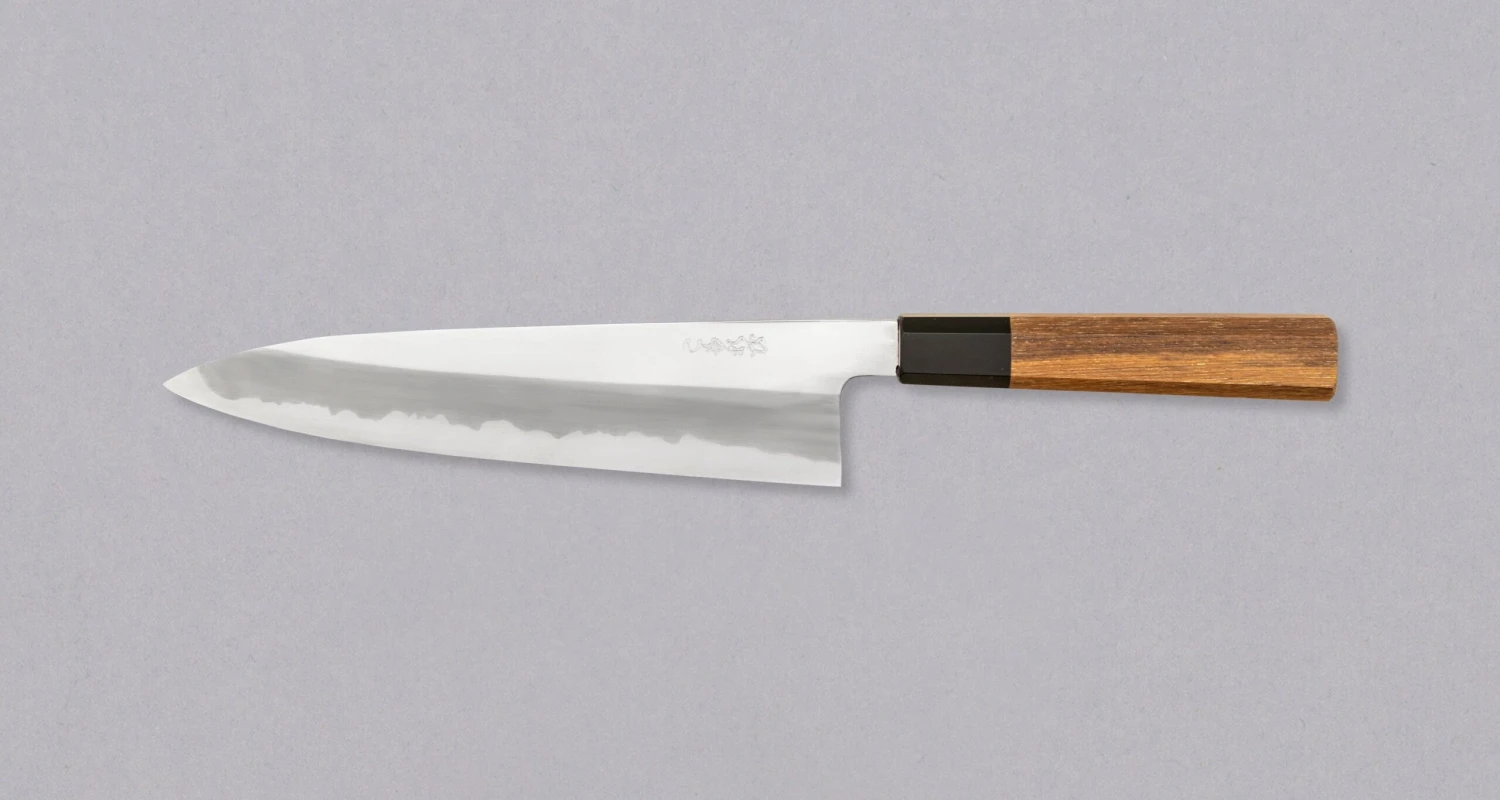
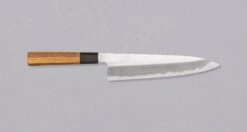
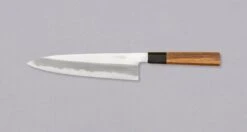
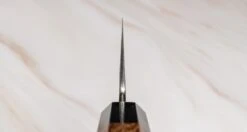
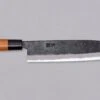

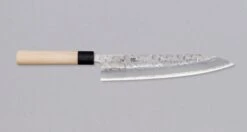
Komorebi Gyuto Aogami #2 Migaki 210mm is a multi-purpose Japanese kitchen knife, suitable for preparing meat, fish and vegetables.
|
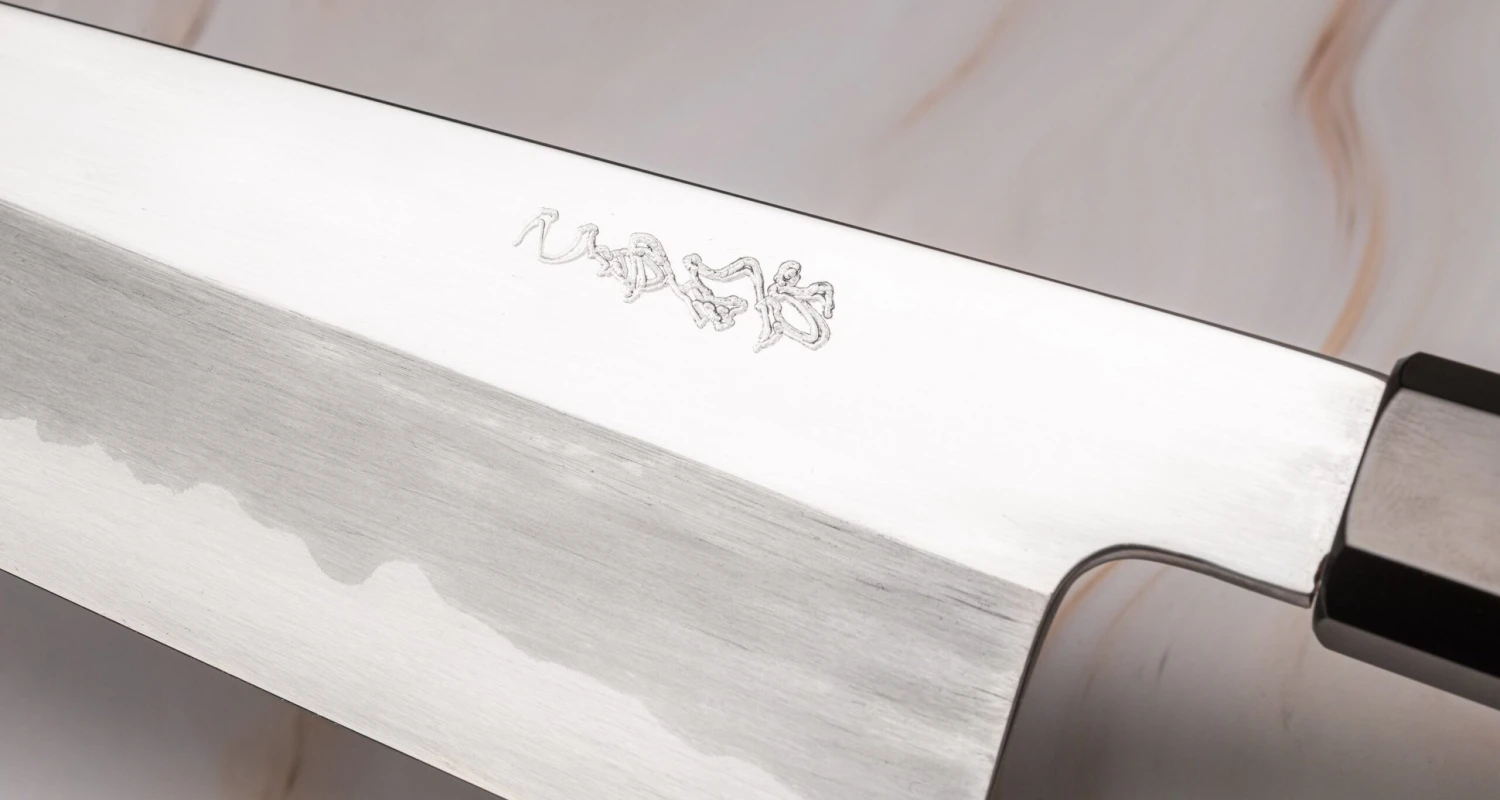
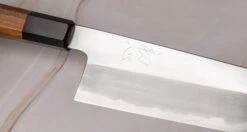
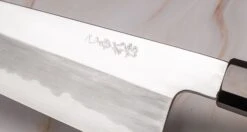
Komorebi (こもれび) is a term that describes the sunlight that streams through the trees, which is felt on warm Japanese summer days. A phrase with such a pureness and calming nature is very fitting for a knife like this, as the spirit of natural beauty directly translates through its features. It’s filled with the beauty of the Japanese blacksmithing art, with techniques and practices that go deep into the history of knife manufacturing. One of those is the kasumi finish, which was applied on the kireha with natural whetstones. This results in a natural appearance that elegantly contrasts the polished migaki finish. |
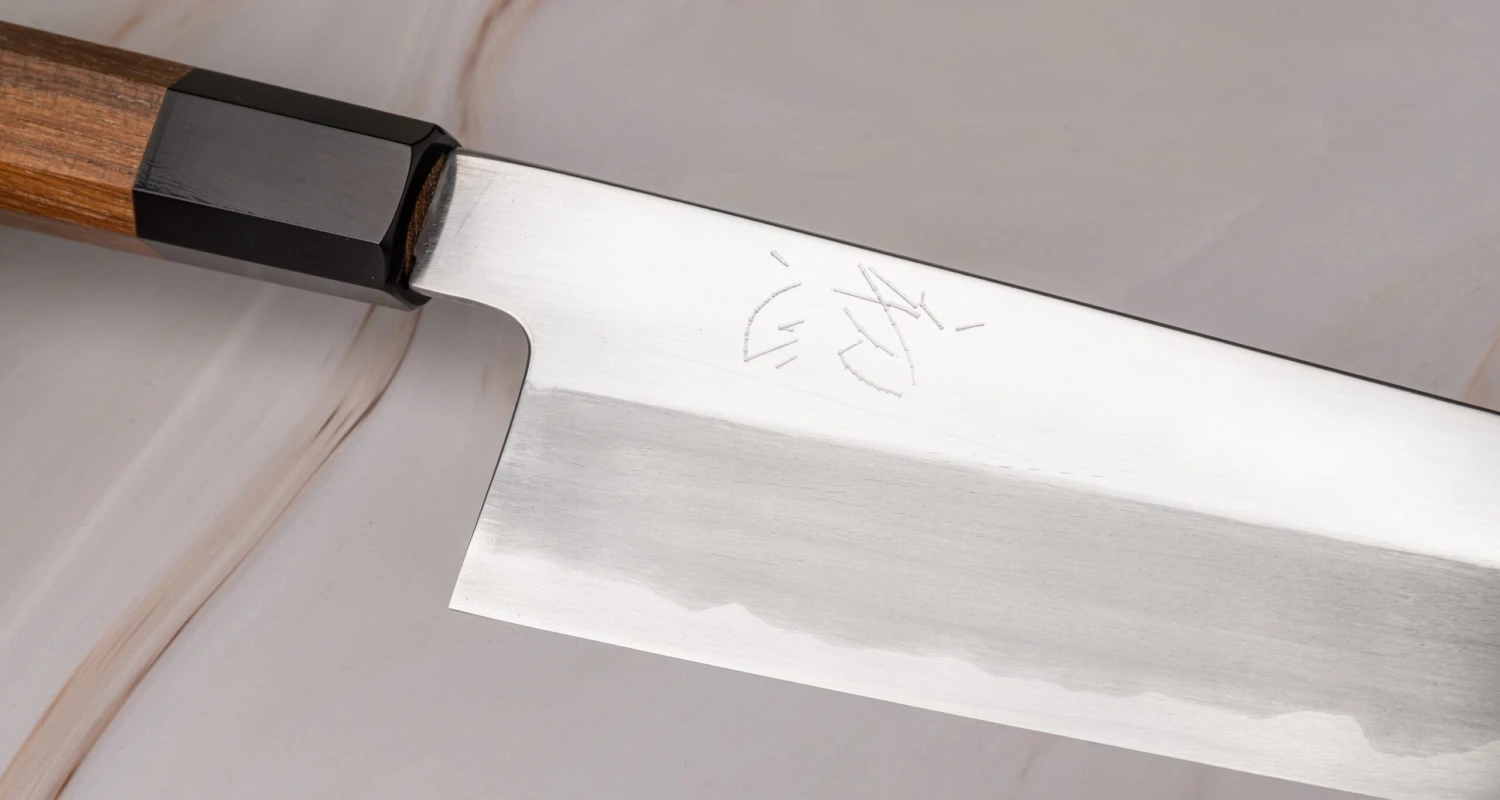
If you look closely, you can also see that there is a small gap where the blade is inserted into the handle, and it might look like the work of a sloppy blacksmith! But it’s actually very intentional. The small exposed part of the tang is called a machi gap and is there to invite adjustments and an easy replacement of the handle. Nowadays, it’s often used as more of a cosmetic feature and a reference to traditional knives.
BLADE SHAPE:
Gyuto is the most versatile and useful blade shape in the modern kitchen. It has a wide profile (52mm) with an extra height clearance for easy food transfer and tends to be fairly flat towards the heel, enabling easy and fast chopping on the cutting board. A pointed tip allows piercing and precise, delicate work. A slight curve between the tip and the midsection makes the belly great for rocking the blade back and forth when cutting. It can be used for cutting meat, fish and vegetables.
STEEL:
Aogami #2 is a very popular steel in Japanese knife making and one of the finest high-carbon steels, meaning the knives forged from it will have excellent edge retention and also sharpen very easily. At the same time, it is less resistant to corrosion, meaning the blade can develop a patina, while longer exposure to water or other corrosives could also lead to rusting. This is improved to some extent with the addition of chromium and tungsten, but it’s still a high-carbon steel that should be maintained accordingly (⚠️ read more about knife maintenance here). Aogami #2 steel is composed of carbon (C) 1.1 %, chromium (Cr) 0.5 %, manganese (Mn) 0.3%, and tungsten (W) 1.5%.
LAMINATION:
The blade was laminated with soft iron, which is iron with only a small amount of carbon added to it. Laminating the blade improves its structural integrity, as the knife’s core is made of hard—and therefore brittle—high-carbon Aogami #2 steel that is prone to breakage on its own.
⚠️ Due to its purity and lack of any added elements such as chromium (Cr), soft iron doesn’t resist corrosion well. Therefore, the upper laminated part can also develop rust when not taken care of properly.
GEOMETRY:
It has a double bevel (symmetrical) blade with a concave V-edge profile (hollow grind). The profile allows the knife to remain extremely thin despite frequent sharpening.
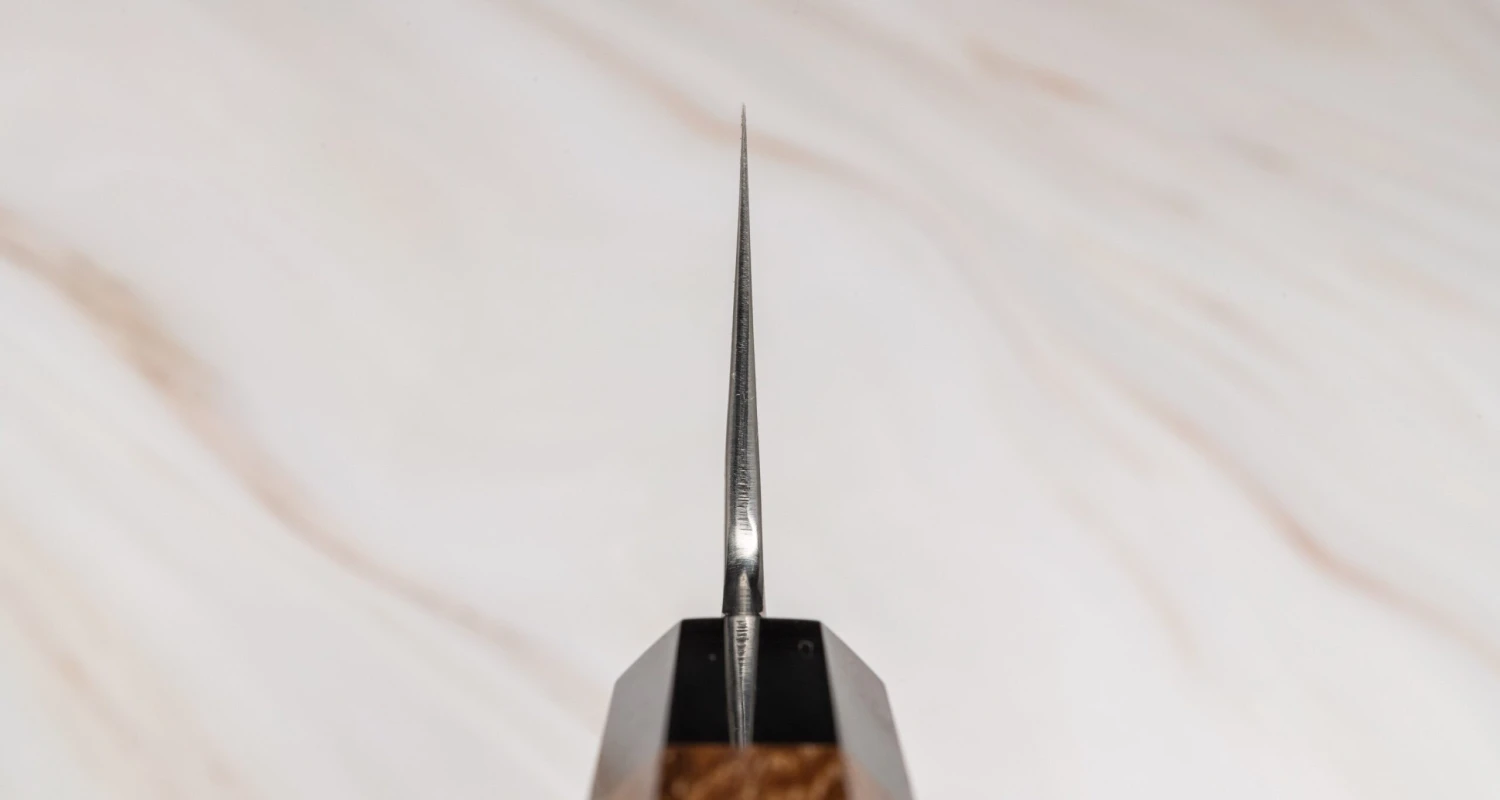
This gyuto is slightly heavier, as the blade at the handle is thicker (3.7mm) and then gradually tapers towards the tip (1.0mm). Viewed from the back of the blade, the knife is heavier and stronger at the handle and thinner and more precise at the tip. This blade shape makes the knife easier to use because the blade is very responsive, easily maneuverable and nicely balanced. This type of blade design is also called distal taper – you can read more about it in the article on blade geometry.
BLADE FINISH:
The highly polished look of the blade is the result of a unique, time-consuming process of polishing the blade with natural whetstones. The hazy appearance of the kasumi line (matte surface above the transition between the harder and softer steel) is in high contrast to the finely polished (migaki) upper part of the blade. The blade has a natural look with a few intentional imperfections (uneven clad line) that make each knife unique. The final look of the blade is the result of highly skilled craftsmanship and high-quality production. You don’t often come upon such a product that doubles as a piece of art.
HANDLE:
Japanese (Wa) style handle made out of teak wood with a buffalo horn ferrule.
Be the first to review “Komorebi Gyuto Aogami #2 Migaki 210mm (8.3″)”
Related products
The Cutting List
![Yu Kurosaki Gyuto Senko R2 270mm (10.6") [Rosewood]](https://www.kniveshotdeal.com/wp-content/uploads/2025/11/KurosakiGyutoSenko270mm_410103201222_1-247x132.webp)
Gyuto [Chef's knife]
Japanese Knives
![Tsunehisa Gyuto Aogami Super Kuro-uchi 210mm (8.3") [Rosewood-Cedar]](https://www.kniveshotdeal.com/wp-content/uploads/2025/11/410103111038-_1__rosewood-247x132.webp)
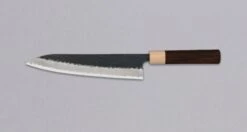
Gyuto [Chef's knife]
Tsunehisa Gyuto Aogami Super Kuro-uchi 210mm (8.3″) [Rosewood-Cedar]
Japanese Knives
Japanese Knives
Gyuto [Chef's knife]
Gyuto [Chef's knife]
Reviews
There are no reviews yet.